
SEANSCÉALTA, GUTHANNA BEO
What Still Lives Here
An exhibition by Justine Guittonny-Cappelli

Myths never reach us intact. The Irish stories that have come down to us have already had several lives, they have been told, copied, translated, forgotten in places, then taken up again and reorganised. They continue to change each time someone reads them, tells them or tries to understand what they might still have to say.
This exhibition was born from this idea. To create these paintings, I asked people to share with me what mythology represented for them today, the place it held in their lives and the way they recognised themselves, or did not, in certain stories. Their answers fed into my work, my choices of figures, symbols, sometimes simply a colour, an expression or an atmosphere.
It was important, however, that these paintings did not close the stories around one particular interpretation. The testimonies are a starting point. I tried to leave enough room in each work for the viewer to bring their own understanding of the myth, their memories, their expectations and the questions they ask themselves today, whether personal or connected to social and political issues. We do not all ask the same thing of stories, and we do not ask the same things of them at different moments in our lives either.
To continue this reflection, I chose to place around the works some of the testimonies that were shared with me. They are all real and tell of a singular relationship with mythology. I was very moved by the trust with which these people agreed to share something that could sometimes be intimate, difficult to explain, or deeply connected to their sense of belonging.
I like that art can become a space for exchange, listening and respect, a place where different interpretations can meet without one needing to erase the others. These stories were transformed long before us, and they will continue to be. This exhibition is an invitation to enter into this transmission, to make the stories our own, to discuss them and to ask ourselves what they have become for us, today.

Visit the exhibition
Dates: Wednesday 2 September to Monday 30 November 2026
Opening evening: Complimentary wine and cheese from 6.30 pm, introductory talk at 7 pm
Venue: Garage Theatre, Monaghan Education Campus, Armagh Road, Monaghan, Co. Monaghan
Admission: Free
Before travelling: The gallery is inside a working theatre. Please check the theatre's current opening hours, particularly if you are coming from outside Monaghan.
Parking: Free parking is available at the Monaghan Education Campus.

The stories are grouped here by cycle
The familiar division into a Mythological Cycle, an Ulster Cycle and a Fenian Cycle is useful for finding one's way through a large body of material, although the stories themselves were never produced as three closed collections. They survive across manuscripts, poetry, prose, place-lore and later oral tradition. The boundaries help us navigate, they should not make the tradition look more orderly than it is.
The Mythological Cycle: Stories of the Tuatha Dé Danann, successive arrivals, otherworld figures and the remembered origins of places.
The Ulster Cycle: Stories centred on the Ulaid, Conchobar's court, Cú Chulainn, and the demands made by heroic reputation.
The Fenian Cycle: Stories of Fionn and the Fianna, where landscape, kinship and the memory of a lost world remain unusually close.
THE MYTHOLOGICAL CYCLE
Fódla, The Mythological Cycle · Watercolour and metallic gold leaf on Magnani 1404 paper, 100% cotton · 30 × 30 cm · 2026

Fódla enters the written record in Lebor Gabála Érenn, the medieval compilation usually called The Book of the Taking of Ireland. It is a deliberately constructed history, bringing biblical chronology, learned speculation and inherited stories into the same account. When the Milesians arrive, Fódla, Banba and Ériu each meet them and ask that the island bear her name. Ériu receives the name most commonly used, while Fódla and Banba remain poetic names for Ireland. The episode is brief, but it leaves three women standing at the point where conquest is turned into a story of legitimate arrival.
I was interested in Fódla because naming is never neutral. A name can hold attachment and memory, but it can also make a claim. She allowed me to think about the land without pretending that belonging is simple, especially in a country whose stories repeatedly begin with arrival.
Nuada Airgetlám, The Mythological Cycle · Watercolour and metallic gold leaf on Magnani 1404 paper, 100% cotton · 30 × 30 cm · 2026
Nuada is king of the Tuatha Dé Danann when they fight the First Battle of Mag Tuired. After losing an arm, he can no longer retain the kingship under the rules preserved in the story. The healer Dían Cécht gives him a working arm of silver, and Miach later restores an arm of flesh. These successive repairs do not erase what happened. They alter Nuada's body, his name and his relation to authority. Even when the kingship returns to him, the interruption remains part of the figure we remember.
The silver hand is visually striking, but I did not want it to work as a simple symbol of overcoming disability. Nuada's story is also about the conditions a society places upon a body before it will recognise that body as fit to lead. Repair is present, yet so are exclusion and dependence on other people's decisions.

Airmed, the Healer, The Mythological Cycle · Watercolour and metallic gold leaf on Magnani 1404 paper, 100% cotton · 30 × 30 cm · 2026

Airmed's story is carried in Cath Maige Tuired. Her brother Miach heals Nuada, and their father Dían Cécht kills him. Plants then grow from Miach's grave. Airmed gathers them on her cloak and begins to arrange them according to their properties, until Dían Cécht scatters them and the order is lost. The episode joins two losses that are difficult to separate: the death of a brother and the destruction of knowledge that had only just begun to become legible.
In the painting, Airmed bends towards the ground and almost disappears into the work of gathering. I did not want grief to become a miraculous cure, or the plants to promise that everything broken can be made useful. Her action is slower than that. She attends to what has grown from the grave, she tries to understand it, and then she has to live with another act of violence. For me, the unfinished ordering matters as much as the healing plants. Knowledge can be interrupted, particularly when it is held by someone whose authority another person refuses to accept.
Ogma, The Mythological Cycle · Watercolour and metallic gold leaf on Magnani 1404 paper, 100% cotton · 30 × 30 cm · 2026
Ogma appears in Cath Maige Tuired as a champion of the Tuatha Dé Danann. Under Bres's rule he is made to carry firewood, an image of strength reduced to compulsory labour. In the battle he fights, and afterwards he takes up the sword of the Fomorian king Tethra, a sword that recounts what it has done. Other medieval learned traditions associate Ogma with eloquence and with the invention of ogham.
The staff, the patterned clothing and the open landscape suggest knowledge carried by bodies, through walking, work, speech and recollection. Ogma is not divided into a warrior on one side and a poet or inventor on the other. I was drawn to the possibility that strength could include the ability to hold words, and that language itself could have weight.

Tailtiu, The Mythological Cycle · Watercolour and metallic gold leaf on Magnani 1404 paper, 100% cotton · 30 × 30 cm · 2026

Tailtiu is remembered as Lugh's foster-mother. In the place-lore of Tailtiu, now Teltown in County Meath, she clears wooded land until it can be cultivated and dies after the labour. Lugh establishes an assembly and funeral games in her memory. Fosterage, land clearance and public commemoration meet in a story where the work that sustains a community is also the work that destroys the person performing it.
Tailtiu is honoured, yet the world made possible by her labour continues without her. This is familiar far beyond mythology, especially in the work expected from mothers and carers, or from people whose effort becomes visible only after it has been exhausted. I did not want to make her sacrifice beautiful enough to become comfortable.
Midir, The Mythological Cycle · Watercolour and metallic gold leaf on Magnani 1404 paper, 100% cotton · 30 × 30 cm · 2026
Midir is one of the central figures in Tochmarc Étaíne, The Wooing of Étaín, a story preserved in several parts and versions. Étaín is separated from him through transformation, lives another human life and becomes the wife of Eochu Airem. Midir returns, plays fidchell with Eochu and gradually raises the stakes. When he finally claims an embrace and a kiss from Étaín, the pair leave through the roof opening in the form of birds. Love, memory and return are present, but so are possession, bargaining and the problem of deciding which life should count as Étaín's true one.
I wanted Midir to retain that uncertainty. He can be read as the lover who crosses time to find Étaín, and also as someone who treats her as the object of a contest between men. The cranes in the painting draw on another strand of medieval imagery connected to Midir and keep the work from becoming a simple illustration of the familiar swan escape. They also bring vigilance and unease into a scene that is often told only as romance.

THE ULSTER CYCLE
Cathbad, The Mythological Cycle · Watercolour and metallic gold leaf on Magnani 1404 paper, 100% cotton · 30 × 30 cm · 2026

Cathbad is the druid of Conchobar's court, a teacher and prophet. In the Táin tradition, the young Sétanta hears Cathbad say that whoever takes up arms on that day will achieve lasting fame but live only a short life. The boy chooses the future that has been spoken, and becomes Cú Chulainn.
I thought about Cathbad less as a remote seer than as an adult speaking in the presence of a child. Knowledge is not neutral in that situation. The painting holds prophecy close to care, because seeing what may happen does not remove responsibility for the way it is said, or for what a young person may feel compelled to become after hearing it.
Scáthach and Aoife, The Mythological Cycle · Watercolour and metallic gold leaf on Magnani 1404 paper, 100% cotton · 30 × 30 cm · 2026
Scáthach and Aoife meet in Tochmarc Emire, The Wooing of Emer, during Cú Chulainn's training overseas. Scáthach is his teacher. Aoife is the formidable warrior who opposes her, and Cú Chulainn defeats Aoife through a trick after learning what she values most. Later retellings often make the two women sisters, although their exact relationship shifts from one version to another.
This painting turns away from the expected combat. Scáthach and Aoife are held in an embrace, surrounded by a flourishing landscape, with gold gathering above them in a form that can recall a halo or an arch. I wanted to leave room for tenderness between two women whom the tradition usually permits us to see as rivals. The image does not claim that reconciliation belongs to an older, hidden version of the myth. It is a contemporary reworking, one that asks what becomes possible when their relation is no longer organised around Cú Chulainn.

Emer, The Mythological Cycle · Watercolour and metallic gold leaf on Magnani 1404 paper, 100% cotton · 30 × 30 cm · 2026

Emer first meets Cú Chulainn through an exchange of elaborate, coded speech. She is valued for intelligence and verbal skill, and she answers him as an equal. Much later, in Serglige Con Culainn, The Sick-Bed of Cú Chulainn, she confronts his relationship with Fand. The story does not resolve itself through a satisfying victory. Fand returns to Manannán, and Cú Chulainn and Emer drink a potion of forgetting. What survives is a settlement created through separation and altered memory.
I was interested in the quiet aftermath rather than the confrontation. Emer is often praised as an ideal wife, which can make her patience feel like a virtue demanded for someone else's comfort. Here, love, pride and injury are allowed to remain difficult to reconcile. Forgetting may reduce pain, yet it also removes part of the truth of a relationship. The painting stays with the cost of continuing after a story has been made bearable, and with the question of who has had to give something up for that continuation to become possible.
The Morrígan, Before the Crossing, The Mythological Cycle · Watercolour and metallic gold leaf on Magnani 1404 paper, 100% cotton · 30 × 30 cm · 2026
The Morrígan enters the Táin in several forms. She approaches Cú Chulainn and is rejected, then opposes him at the fords as an eel, a wolf and a hornless heifer. He wounds each form. Later she appears as an old woman milking a cow, and he unknowingly heals the wounds through his blessings. Conflict, desire, disguise and recognition are folded into the same sequence, so that no single description of her role is sufficient.

Medb, The Mythological Cycle · Watercolour and metallic gold leaf on Magnani 1404 paper, 100% cotton · 30 × 30 cm · 2026

At the beginning of Táin Bó Cúailnge, Medb and Ailill compare their wealth. They are equal until Ailill's great bull creates a difference that Medb cannot match. Her attempt to borrow Donn Cúailnge collapses into the cattle raid that drives the story. Medb is a queen with military and sexual agency, but the text does not turn that agency into moral purity. Her decisions draw kingdoms into violence, while the young Cú Chulainn holds the Ulster army at the fords.
I did not want Medb to become either a feminist heroine cleaned of consequence or a warning against ambitious women. Equality in the story is measured through possession, and the effort to correct one imbalance produces losses far greater than the original offence. That contradiction is what keeps her interesting to me. She is strategic, commanding and often unsettling.
THE FENIAN CYCLE
Muirne, The Mythological Cycle · Watercolour and metallic gold leaf on Magnani 1404 paper, 100% cotton · 30 × 30 cm · 2026
Muirne is the mother of Fionn, although her part of his origin is often compressed into the beginning of his story. Her father opposes her relationship with Cumall, and the surviving versions do not all present that relationship in the same way. Cumall is killed before the child is born. Muirne gives birth to Demne, the boy later known as Fionn, while his father's enemies remain a threat, and his upbringing is entrusted to the women Bodhmall and Liath Luachra.
The celebrated lineage begins with pregnancy, danger and a set of decisions made by women, yet the hero soon occupies almost all the available space. This painting returns attention to what precedes him. Muirne is not simply a container for Fionn's importance, and motherhood does not make her experience transparent. I wanted the risk, the bodily labour and the difficulty of protecting a child within a violent political story to remain present, even though the later tradition looks ahead to the man he will become.

Fionn mac Cumhaill, The Mythological Cycle · Watercolour and metallic gold leaf on Magnani 1404 paper, 100% cotton · 30 × 30 cm · 2026

Fionn's childhood is told through concealment, training and several changes of name. In the best-known wisdom episode, he cooks the salmon intended for the poet Finnéces, burns his thumb and tastes the fish by accident. Knowledge becomes available through the body, returning when he touches the thumb to his mouth. His hounds Bran and Sceólang also carry family history, since the stories connect them to a woman transformed while pregnant.
I wanted to move away from the familiar warrior representation. Here, he is still very young. The salmon, the hounds are already present, but they are possibilities rather than fate. The story is around him, waiting, but he is not yet trapped inside it. He still has choices.
Oisín, The Mythological Cycle · Watercolour and metallic gold leaf on Magnani 1404 paper, 100% cotton · 30 × 30 cm · 2026
Oisín is the son of Fionn and Sadhbh, whose story is marked by transformation into a deer. He belongs to the Fianna as a warrior and poet, then becomes one of the figures through whom their vanished world is narrated to a later, Christian Ireland. The journey with Niamh to Tír na nÓg is the version most people now know. It comes to us especially through later poetry and folklore, which is itself part of the long life of the Fenian material rather than a lesser addition to it.
I painted the young and the old Oisín together. The deer recalls Sadhbh and his birth, while the white horse holds the journey with Niamh and the condition of his return. The two ages cannot meet in ordinary time, yet the story makes both necessary. Oisín carries the Fianna after they are gone, and survival becomes a form of displacement. He has knowledge of a world that the people around him cannot enter, while the place to which he returns no longer contains the life he expected to find.

Niamh, The Mythological Cycle · Watercolour and metallic gold leaf on Magnani 1404 paper, 100% cotton · 30 × 30 cm · 2026

Niamh Chinn Óir, Niamh of the Golden Hair, comes from Tír na nÓg and chooses Oisín. She offers a life outside ordinary ageing and carries him there on a white horse. When he wishes to see Ireland again, she lends him the horse and warns him not to touch the ground. The warning cannot protect him from the change that has already taken place. Once he falls, the years arrive at once, and the shared world to which he might have returned with her is closed.
Niamh is often treated as the beautiful means by which Oisín reaches the Otherworld, then left behind when his loss becomes the centre of the story. I wanted to think about what the departure costs her as well. She cannot preserve a life simply by loving it, and she cannot make two different experiences of time agree. The painting holds her near that threshold, between invitation and separation. Her warning is an act of care, but care does not always have the power to prevent the thing it fears.
Oscar, The Mythological Cycle · Watercolour and metallic gold leaf on Magnani 1404 paper, 100% cotton · 30 × 30 cm · 2026

Oscar, son of Oisín and grandson of Fionn, is remembered as one of the Fianna's greatest warriors. He dies at the Battle of Gabhra, where the old order breaks apart through conflict involving kingship, obligation and divisions within the Fianna. The death is frequently used to mark the end of an era. Oscar's value to the tradition is therefore tied both to his prowess and to the grief his loss makes possible for the people who survive him.
In the painting he is unarmed. His body rests among textiles, and the landscape seems to emerge from the folds around him, held within a circle of gold. I wanted to separate him for a moment from the function he has been given as a warrior. The pose makes room for vulnerability and for the person carried inside inherited expectation. Oscar has received a family story in which courage is already defined before he can choose its meaning. At Gabhra, that inheritance reaches its limit, and those who loved him are left to understand what their heroic world demanded from its young.
Gráinne, The Mythological Cycle · Watercolour and metallic gold leaf on Magnani 1404 paper, 100% cotton · 30 × 30 cm · 2026
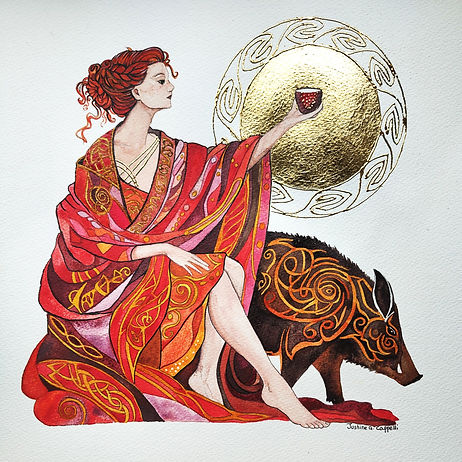
Gráinne, daughter of Cormac mac Airt, is promised to the older Fionn. During the wedding feast she places Diarmuid under a geis and requires him to flee with her. The pursuit that follows is often retold as a romance, yet coercion is present from its first decisive act. Fionn's claim, Gráinne's refusal, Diarmuid's obligation and the danger imposed on everyone around them do not settle into a simple account of freedom. Later versions continue beyond the flight, through settlement, children and Diarmuid's death after the boar hunt.
Gráinne interested me because she resists the limited positions available to her, and because resistance does not make every consequence disappear. She can be brave, strategic and difficult at the same time. The story asks what choice means when the alternatives have been arranged by other people, and what happens when one person's escape becomes another person's binding command. I did not want the painting to decide whether she should be celebrated or condemned. The uncertainty belongs to the story, and to many choices made under pressure.
Voices from the Exhibition
These testimonies were shared in response to a simple question about what Irish mythology means in people's lives now. Some describe a first encounter with a story. Others show a mythological figure becoming part of illness, migration, family history or the difficult work of setting a boundary.
An opening talk by Dr Lauren Cassidy
Lauren Cassidy's talk begins with the instability of oral transmission and follows the marks left by copying, Christian scholarship, colonial history and revival. Rather than looking for an untouched original myth behind these layers, she considers what the layers allow us to see. Brigid, the sovereignty figure and the women of Lebor Gabála Érenn become examples of stories that have repeatedly carried the concerns of the present in which they were told.
Acknowledgements
With thanks to the people who trusted me with their testimonies, to Dr Lauren Cassidy for opening the exhibition and adding her own reading to it, and to Eileen Costello and the team at the Garage Theatre for giving the work a place to be seen and discussed.
This exhibition was developed with the support of Monaghan County Council's Emerging Talent Award 2025.
